
LIFT SHAFT GATES
Temporary door closure system that prevents unauthorised access into door openings that could lead to fatal falls.
The Lift Shaft Gate is the safe and versatile alternative to other safeguards for lift shafts in civil engineering. On the one hand, this temporary shaft door protects the construction site personnel from accidents and functions as a fall protection in this respect. On the other hand, it ensures easy access to carry out work inside the shaft. The Lift Shaft Gate can be installed from the outside as well as from the inside, with the help of the fixing brackets and suspension tubes. The upper door can be opened separately, e.g. to allow tools to be handed in.
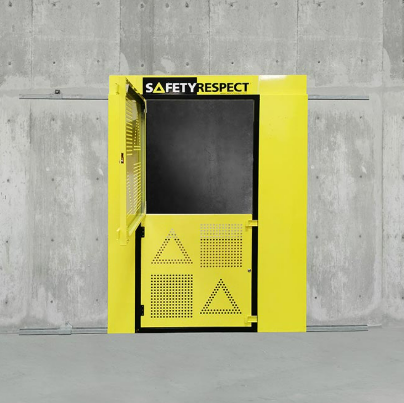
The built-in triangular lock prevents uninvited access to the shaft, yet the intelligent design allows the entire door to be opened from the inside without a key to ensure smooth escape in case of fire or danger. The door, which weighs less than 40 kg, can easily be adapted to the structural conditions for wider shaft openings. For this purpose, the panels are used to fill the desired width. Panels and door can be set up in various combinations to customize according to specific needs. Gap covers for attachment to the upper end of the Lift Shaft Gate complete the range.
CATCHFANS
Catchfans are manufactured for compliancy to EN-1263-1 Type T.
Available for hire and sale.
Catchfan’s are framed, double layered safety net’s designed to catch, absorb the energy and contain falling items, debris and personnel that may fall or be accidentally dropped during the construction of multi-level concrete or steel structures. The fan absorbs the energy of the falling object before it hits the ground protecting anyone working within the vicinity of the structure. They are commonly used to protect pedestrians or over trainlines.
Catch fans are used as a collective safety measure which can be installed without any need of cranes and is designed to be installed vertically or horizontally on floor structures, scaffolds and walls up to six meters below the working area.
A fine mesh layer is fixed to the net to catch smaller objects. Fallen objects are retrieved by simply folding the net to gain access. They can easily be moved and adapted throughout the construction project. Easy to fold to a vertical position in order not to interfere with cranes.
They will catch and absorb the energy of falling object or debris, ensuring that they don’t bounce out of the net. They can also protect the public in busy environments.
Please click this link for Catchfan technical information
https://www.safetyrespect.co.uk/products/catch-fans/

WORK RESTRAINT
The Work at Height Regulations 2005 state that employers have a responsibility to prevent falls by following control measures from the Work at Height hierarchy.
These measures control the stages that must be followed when working at height is required with the safest precautions first, these being to plan work avoiding working at height if necessary.
The next stage is Collective Protection which means that all work is carried out behind a Guardrail, usually a Temporary edge protection system which does not require action from those protected by it.


Work Restraint is placed in the work at height hierarchy as the preferred method for fall prevention when collective measures are not in place. It protects those using it by restricting their movement within a safe working zone, preventing them from reaching the fall hazard.
A Work Restraint System is designed to restrict the user when required to operate adjacent to an unprotected or leading edge of a structure with access to a wider working area ( up to 20 metres per Running-Line ) without transferring between anchorage points.
A common example of this is when unitised façade systems are installed onto the side of structures where a Temporary edge protection system prevents access for installers to the edge of the floors for fixing brackets and panels so a Temporary Work Restraint System – often called Running-lines will be installed inside the structure, running parallel to the edge of the slab offering an unobstructed restraint for several installers simultaneously.
FALL ARREST
The Work at Height Regulations 2005 state that employers have a responsibility to prevent falls by following control measures from the Work at Height hierarchy.
These measures control the stages that must be followed when working at height is required with the safest precautions first, these being to plan work avoiding working at height if necessary.


Fall arrest is the final step in the hierarchy of control for preventing falls at work, and should only be used after all other options have been considered.
A fall arrest system physically links the user to the structure using a series of connected components designed to arrest the free fall of the user by decelerating the user through a short arrest distance by applying an arresting force.
When a fall arrest system is used, there are four phases to a fall.
— initiation, i.e. the cause of the fall.
— the fall where injury can occur as a result of impact with the structure
— the fall arrest, where injury can occur by the violence of the impact as the fall is arrested
— during the suspension phase due to suspension trauma.
A Fall Arrest System consists of three components
Full Body Safety Harness
Connecting Device – Lanyard or Self-retracting Fall Arrestor
Anchorage Device.
ANCHORAGE DEVICE
Anchor points are a vital part of a fall protection system. they are the critical component that connect Work Restraint, Fall Arrest systems and Rescue systems to the permanent structure.
Principally there are three methods of Anchorage

Cast-in anchors systems
https://safetyrespectstore.co.uk/product-category/scissorsafe-system/
A Cast-in anchor system such as Scissorsafe is incorporated into the design of the structure offering economical benefits by removing the need to drill for anchor points and eliminating the need to load-test friction reliant anchors before a Personal Fall Protection system can be connected to them.
Early planning of safety system’s invites collaboration between the Principle Contractor, responsible for implementing a safe system of work, The Frame Contractor who will progressively cast anchors into the structure and External Envelope Contractors who will use these pre-installed Anchor Points for Work Restraint.
Post-drilled anchors.
https://safetyrespectstore.co.uk/product-category/post-drilled-anchors-fall-arrest-anchor/
Post-drilled anchors offer the versatility of positioning anchors where needed when there isn’t a column or beam to anchor to.
Post-drilled anchors are not as economical as cast-in anchors because they need an expendable thread and should be load-tested before use because they rely on friction between anchor and concrete.
Click this link to view our Post- Drilled Anchor movie
https://youtu.be/6lm-RYJzcs4?si=R4QRt1UkPr91P9Bm
Click this link to view our Anchor load-testing movie


Anchor Slings
Wrapping slings around a permanent column or around reinforcement starter bars when on a live formwork system offers an economical and effective method of anchorage for a horizontal lifeline / running-line.