You can see an overview movie of the Scissorsafe system here

Scissorsafe is a Fall Protection System for Reinforced Concrete Framed Structures which allows workers to safely access leading edges and perimeters using overhead anchor points.
Due to its unique features, simplicity in use and economic benefits Scissorsafe System has been successfully used in many prestige projects in the United Kingdom and Europe.
MAJOR BENEFITS OF THE SCISSORSAFE SYSTEM
Elimination of Drilling: By casting points directly into the concrete, the system removes the need for drilling, which reduces dust, noise, vibration, and the risk of damaging post-tensioned cables.
No Load-Testing Required: Because the system is mechanically locked into the concrete structure rather than relying on friction, it does not require on-site load testing like traditional expansion anchors.


Early Implementation: Safety is planned at the design/CAD stage, allowing for strategic placement of anchors for facade installation, balcony work, and edge protection.
Reusability & Life-Cycle Safety: Anchors can be reused throughout the project. After construction, the voids can be sealed with a cover disk and later reopened for building maintenance or repairs.
Scissorsafe Anchor points are cast into concrete slabs to avoid drilling using plastic Void Formers which are simply nailed to decking formwork, usually to a plan layout prepared by SafetyRespect.
When the formwork is removed, the anchorage points are exposed in the soffits.
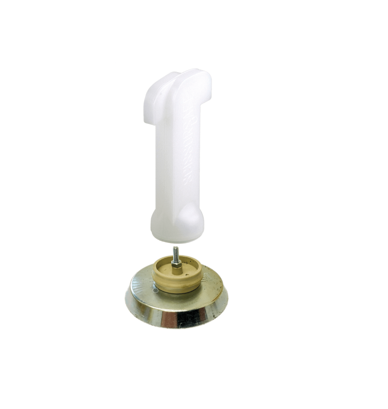
A Scissorsafe Void Former is an expendable plastic moulding used to form the shape of the Anchors in the concrete that allows the insertion of a Scissorsafe re-usable anchor device to connect personal fall protection systems to for Work Restraint or Fall Arrest. They consist of two parts
Nailing Disk. This is fixed to formwork decking usually nailed but can be screwed.
Tee-Mould, this forms Anchor shape into the concrete thats poured around it and is fixed by simply pushing it down onto the Nailing-disk.

Scissorsafe Anchors are unique because they mechanically open in concrete voids cast using Scissorsafe Void Formers then act as a simply supported anchor as opposed to being friction reliant.
A big benefit of this anchor working mechanically as opposed to relying on friction between the anchor and concrete is that load-testing can be avoided.

When inserted into a Void Former and opened they are locked by inserting an Oval Karabiner.
Scissorsafe as a Cast-in anchor system incorporated into the design of the structure offers safety and economical benefits by removing the need to drill and load-test post-drilled anchors that can be used to support Work Restraint (Running-Lines) and Fall Arrest systems for installing curtain-walling, unitised facades and balcony installation.

A 35mm diameter circular disk is nailed or screwed to horizontal formwork in pre-designed locations.
A Tee shaped mould is pushed firmly onto the disk to form an inverted void in the concrete.
Scissorsafe Anchor’s are inserted and deployed in this void when fall arrest or work restraint anchorage is required.


When designed for supporting a Work Restraint System ( generally known as Running-Lines ) Scissorsafe Void Formers are set-out and cast into the concrete in pairs- between 300 and 450mm apart.
This increases the anchor load resistance by distributing the end load on the Horizontal Lifeline over two anchors.


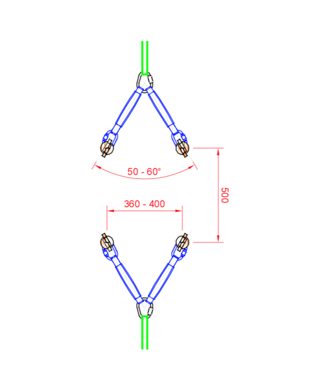
This is a standard detail where Scissorsafe Void Formers are positioned at the end of a concrete slab or up against a wall.
This is the standard detail for placing Scissorsafe Void Formers for Horizontal Lifelines ( Running-Lines) at the corner of a concrete slab
This is the standard detail for mid-span positions when the length of the structure exceeds 20 metres, the length of a Horizontal Lifeline ( Running-Line)

TECHNICAL SUPPORT

We can prepare a provision design layout showing Anchor Points and Horizontal Lifeline coverage with a schedule of parts per floor level.
WORK RESTRAINT / RUNNING-LINES
A Temporary Work Restraint System is used to protect those working on open edge of structures when temporary edge protection is not in place.
It protects those using it by restricting their movement within a safe working zone, preventing them from reaching the fall hazard.
Work Restraint is placed in the work at height hierarchy as the preferred method for fall prevention when collective measures are not in place. A common example of this is when unitised façade systems are installed onto the side of structures where a Temporary edge protection system prevents access for installers to the edge of the floors for fixing brackets and panels so a Temporary Work Restraint System – often called Running-lines will be installed inside the structure, running parallel to the edge of the slab offering an unobstructed restraint for several installers simultaneously.

SINGLE ANCHOR POINTS
Scissorsafe Void Formers can be used into precast concrete floor slabs if they are cast in formwork shuttering.
In Steel formwork a Pedestal magnet is fitted with a Scissorsafe Nailing Disk which remains on the magnet for repeated use.
Scissorsafe Void Formers have been cast into precast slabs in top, bottom and vertical pours.

CERTIFICATION
The Scissorsafe Anchorage System is certified to BS EN 795 class B- Portable Anchorages, Independently assessed under strict conditions to comply with the requirements of European Conformity.